| “Plaza for Everyone” Communication Bus visits Gunsan… Policy proposal to prevent and improve circumv | |||
|---|---|---|---|
| 작성일 | 2025/07/15 | 조회수 | 1042 |
| 첨부파일 | |||
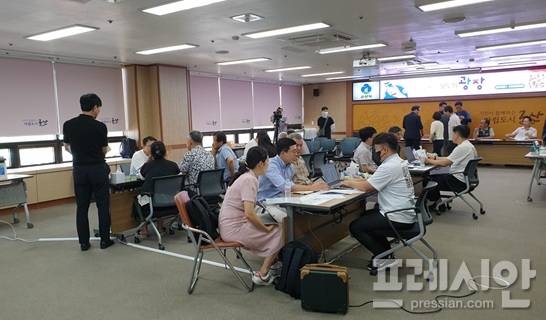
 By Jeong-hoon Kim (Gunsan) July 11, 2025, 12:14 PM
Expectations rise for restoring the effectiveness of SME protection provisions and closing loopholes in the Subcontracting Act
As the “Plaza for Everyone” Communication Bus operated by the Presidential National Planning Committee under the People’s Sovereignty Government visited Gunsan, North Jeolla Province, a local small and medium-sized enterprise drew attention by proposing policy measures to prevent and improve the circumvention of the Subcontracting Act by large corporations.
Company A, located in the Gunsan Free Trade Zone, explained that amendments to the current Subcontracting Act?specifically Article 20 (Prohibition of Evasive Acts) and Article 35 (Liability for Damages)?are necessary. The company stated that such revisions would restore the effectiveness of mandatory domestic provisions designed to protect SMEs and prevent the abuse of disguised “agreements” arising from imbalances in bargaining power between contracting parties.
A company representative noted, “The current Subcontracting Act is a mandatory statute intended to protect the transactional position of SMEs. Article 20 clearly stipulates that a principal contractor must not engage in acts that seek to substantially evade the application of the Act through indirect or evasive means in subcontracting transactions.”
▲ The National Planning Committee’s “Plaza for Everyone” Communication Bus in Gunsan ⓒPressian
However, it was emphasized that in reality, large corporations often apply foreign laws to circumvent mandatory domestic regulations through indirect means, resulting in significant losses for small and medium-sized enterprises (SMEs), which lack comparable financial resources and capacity to respond.
As an example, it was argued that large corporations force SMEs to accept international arbitration clauses as a precondition for doing business, designate foreign laws as the governing law of contracts, and set court jurisdiction or arbitration venues in locations such as London, United Kingdom.
In such circumstances, even when large corporations breach contracts, SMEs are often unable to pursue claims for damages due to limited knowledge of arbitration procedures and foreign legal systems, a lack of information on foreign legal representation and fees, and prohibitively high litigation costs that are beyond their financial capacity.
The company strongly criticized such practices, stating that the frequent use of overseas arbitration systems?under the guise of “mutual agreement” while exploiting imbalances in bargaining power between large corporations and SMEs?constitutes a representative case of evading Korea’s Subcontracting Act.
In this regard, a representative of Company A proposed adding a provision to clearly establish that circumvention of the current Subcontracting Act constitutes an illegal act, stating that “a principal contractor shall not engage in acts intended to substantially evade the application of this Act through indirect means, including the use of foreign governing laws, foreign court jurisdiction, or overseas arbitration venues in connection with subcontracting transactions.”
The representative further requested that Article 35 of the Subcontracting Act (“Liability for Damages”) be amended to include language stating that “where a party suffers damages as a result of a principal contractor’s violation of the prohibition on evasive acts, the principal contractor shall be liable for compensation within the scope prescribed in the following provisions; provided, however, that this shall not apply where the principal contractor proves the absence of intent or negligence.”
In closing, the company representative emphasized that amendments clarifying the prohibition of evasive acts and liability for damages under the Subcontracting Act would restore its effectiveness in protecting SMEs, enable meaningful remedies without being blocked by structural barriers such as foreign arbitration, and ultimately eliminate blind spots in the enforcement of the Act.
In this context, the People’s Sovereignty Government, which was newly inaugurated in June, plans to pursue an expanded organizational restructuring under the Fair Trade Commission?including the establishment of dedicated divisions for subcontracting, franchising, and distribution agencies?in line with President Lee Jae-myung’s pledge to realize a fair economy.
This move is seen as signaling the government’s determination to expand and strengthen the Fair Trade Commission to eradicate unfair practices by large corporations?such as technology misappropriation, forced price reductions, and excessive penalty demands?raising attention to whether the proposed improvements to the Subcontracting Act will lead to formal amendment bills at the government and National Assembly levels.
|
|||

| 이전글 | Energy En selected for the Nuclear Export First Step Program for SMEs (Cohort 2) | 2025/07/15 |
|---|---|---|
| 다음글 | Mobile “Plaza for Everyone” - preventing circumvention of subcontracting laws | 2025/07/15 |